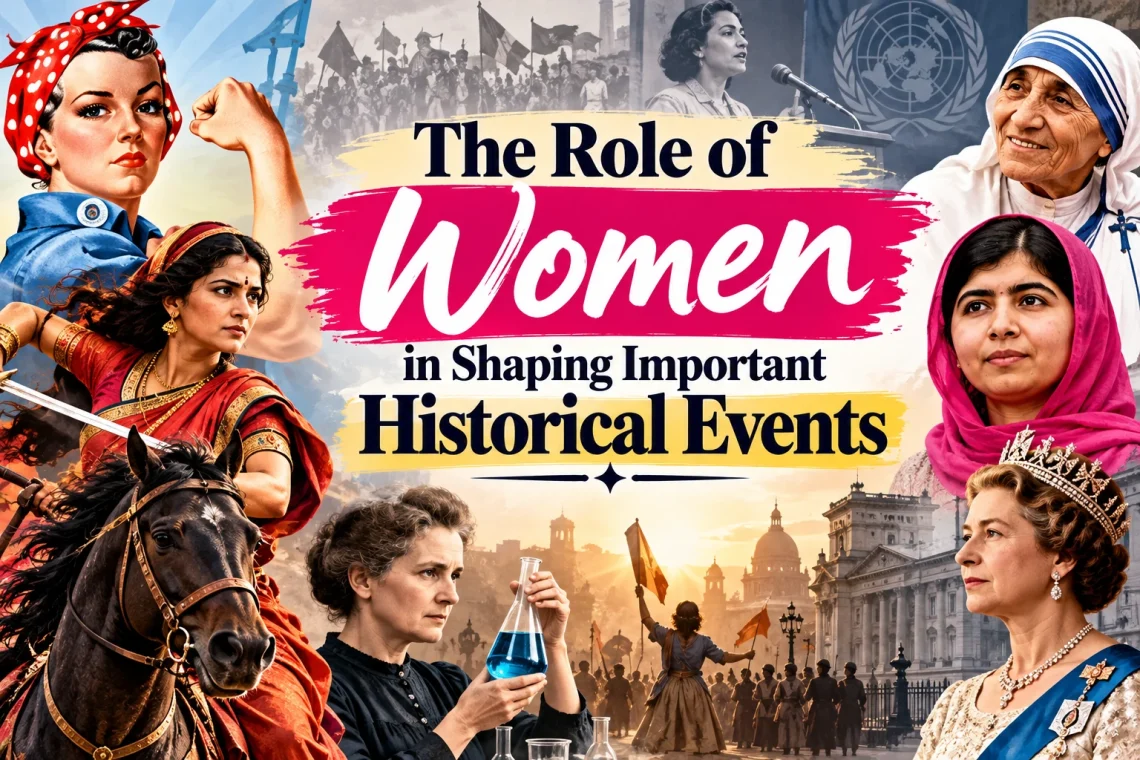
History is often presented through the achievements of kings, generals, politicians, explorers, and other prominent men. Yet women have also played significant roles in shaping political movements, social change, science, culture, and major historical events. Their contributions have taken many forms, from ruling kingdoms and leading resistance movements to organizing communities, creating influential ideas, and campaigning for social reforms.
Women as Political Leaders
Women have held positions of political authority in many different societies. Some became monarchs, while others exercised influence through diplomacy, administration, or political alliances.
Cleopatra VII, the ruler of Ptolemaic Egypt, is one well-known example. Her reign involved complex political relationships with the Roman Republic during a period of significant change in the Mediterranean world.
In other parts of the world, women rulers also influenced government and diplomacy. Empress Wu Zetian of China became the only woman to officially rule China as emperor in her own right. During her period of power, she supported administrative and cultural developments while navigating a highly competitive political environment.
These examples demonstrate that women were not simply observers of political history. Some directly participated in decisions affecting entire states and populations.
Women and Social Reform
Women also played important roles in campaigns for social change. During the nineteenth and twentieth centuries, women became increasingly involved in movements addressing education, voting rights, labor conditions, legal equality, and other social issues.
The women’s suffrage movement provides a major example. Activists organized meetings, wrote publications, participated in demonstrations, and built political organizations to campaign for women’s voting rights.
Their efforts took place across different countries and developed in different ways. The movement demonstrated how organized citizens could challenge established political systems and contribute to changes in law and public attitudes.
Women in Independence Movements
Women have also participated in movements for national independence and resistance to foreign rule.
Rani Lakshmibai of Jhansi became an important figure during the Indian Rebellion of 1857. She participated directly in military resistance and later became a lasting symbol associated with resistance and courage.
Elsewhere, women contributed to independence movements through political organization, fundraising, communication, education, journalism, and direct participation in resistance activities.
These contributions show that independence movements were often broader social movements involving people from many different backgrounds.
Women in Science and Discovery
Women’s influence on history extends beyond politics and warfare. Scientists, mathematicians, researchers, and inventors have made discoveries that changed the development of modern society.
Marie Curie was a pioneering scientist whose research into radioactivity contributed significantly to scientific understanding. She became the first woman to receive a Nobel Prize and remains one of the most recognized scientists in modern history.
Other women worked in fields where they initially received less recognition than their male colleagues. Their experiences highlight how social structures could affect whose contributions were remembered and celebrated.
Women and the Civil Rights Movement
Women were also important participants in twentieth-century civil rights campaigns. They organized communities, supported demonstrations, created networks, and challenged discriminatory systems.
Rosa Parks became internationally known after her 1955 arrest for refusing to surrender her seat on a segregated bus in Montgomery, Alabama. Her action became an important event in the Montgomery bus boycott, although the broader movement involved many organizers and community members.
Women such as Ella Baker also played significant organizational roles in the American civil rights movement. Her work emphasized grassroots participation and the importance of developing local leadership.
Women in Literature and Culture
Historical influence is not limited to political events. Writers, artists, journalists, and filmmakers have also shaped public conversations and cultural attitudes.
Authors such as Jane Austen, Mary Wollstonecraft, Virginia Woolf, and many others produced works that influenced literature and discussions about society, education, gender, and individual identity.
Their writing helped create new ways of thinking about social roles and human experiences. Literature can influence history indirectly by changing how people understand themselves and their communities.
Why Women’s Contributions Were Sometimes Overlooked
For centuries, many societies limited women’s access to education, political institutions, property ownership, and professional careers. Historical records were also frequently produced by institutions dominated by men.
As a result, women’s contributions were sometimes recorded less extensively or interpreted through the achievements of male relatives and leaders.
Modern historians increasingly examine letters, diaries, newspapers, oral histories, legal records, and community archives to better understand women’s experiences and contributions.
A Broader Understanding of History
Recognizing women’s roles does not replace traditional historical narratives; it expands them. Major historical events were rarely created by one individual. They usually involved networks of political leaders, workers, families, activists, soldiers, educators, writers, and ordinary citizens.
Women were part of these networks in countless ways. Some held formal authority, while others influenced events through community organization, education, cultural work, scientific research, or everyday resistance.
Studying their contributions provides a more complete understanding of how societies developed and changed. It also demonstrates that history is shaped not only by those whose names appear in textbooks, but by millions of people whose actions collectively influence the course of events.